AI tool updates October 2026: what changed for designers
AI tool updates for October 2026, checked on each vendor's own pages: Nano Banana 2.1, Kling 4.0, Claude Motion, Eleven v4, Figma code layers, and what to try.
Published 11 min read
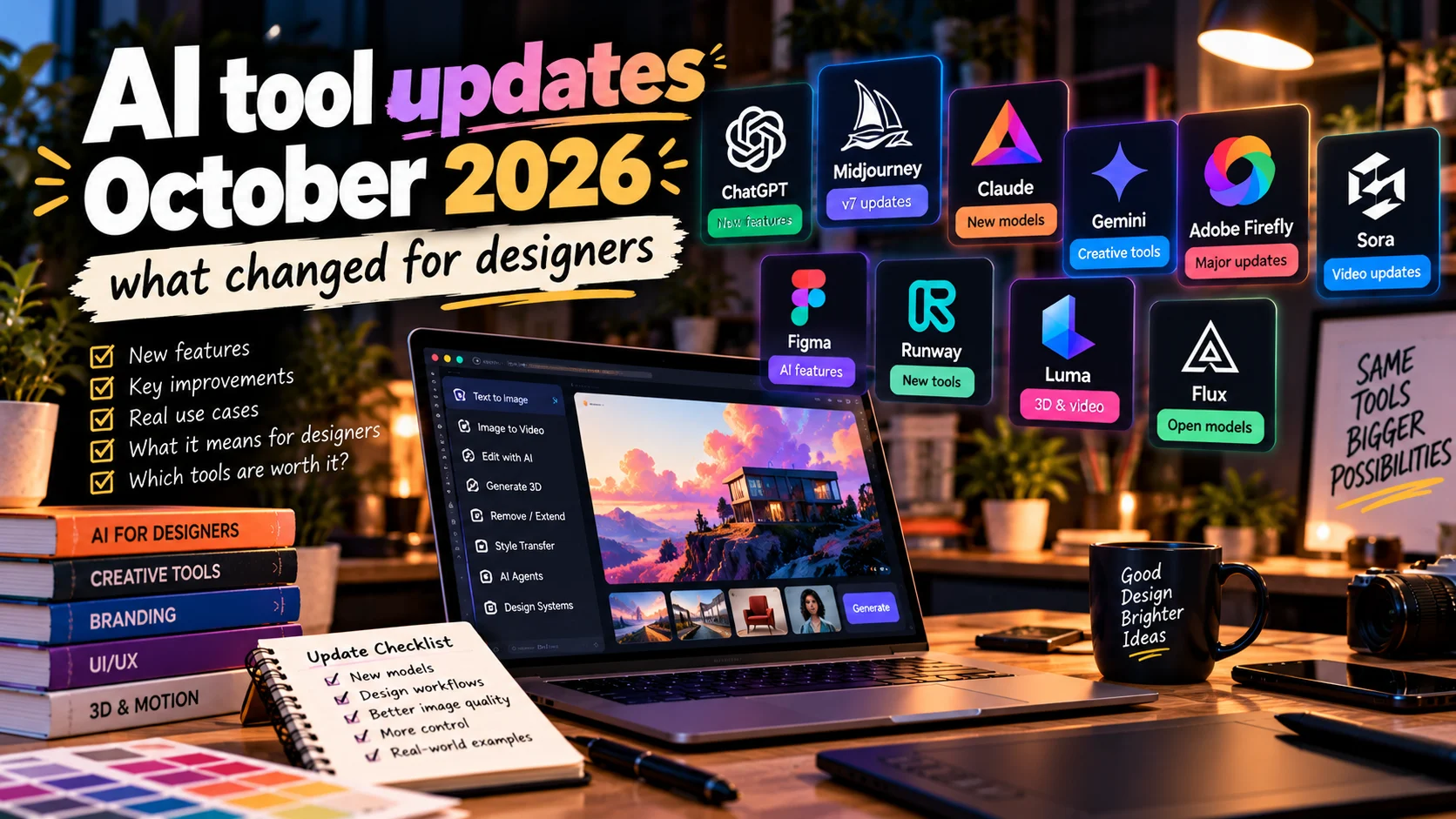
The AI tool updates of October 2026 that matter most to designers come down to three. Google released Nano Banana 2.1, an image model with better text and editing. Kling released version 4.0, which makes up to 30 seconds of video in one generation. And Anthropic put Claude Design on every plan and added Claude Motion for animated explainers.
Checked on 24 October 2026. This covers late September to 24 October 2026. Every item was checked on the vendor's own page (blog, newsroom, changelog or release notes) and carries its date. Anything I could only find on third-party sites, or as a rumour, is left out.
This is the first edition of a monthly roundup. Each item gets three lines: what changed, what it means, and whether it is worth trying now. For the wider picture, start with my guide to AI in graphic design.
The three changes that matter most
- Nano Banana 2.1 (6 October). Clearer in-image text and steadier characters across edits: the biggest change for anyone editing product shots.
- Kling 4.0 (28 September to 15 October). Up to 30 seconds in one generation and up to 10 keyframes.
- Claude Design for everyone, and Claude Motion (8 October). Designs, decks and docs on every plan, plus explainers built as code.
Google: Nano Banana 2.1 and brand styles in Gemini
Nano Banana 2.1
What changed. On 6 October 2026 the Gemini API changelog made Nano Banana 2.1 generally available, with better quality, prompt adherence, character consistency and text rendering, and improved wide ratios such as 4:1 and 8:1, up to 4K. It takes up to 14 reference images, and Google DeepMind says it beats earlier versions at mask-based editing. In the Gemini app it needs a Google AI plan (Pro, Plus or Ultra); Nano Banana 2 stays free.
What it means. The wide ratios suit web banners and roll-up signs. Google's own model card lists the limits: small text can be blurry at 1K, left and right sometimes get confused, and it says nothing about Arabic.
Worth trying now? Yes, if you subscribe. Use your own product photos and keep headlines as live type. My Nano Banana prompts for designers are a sound starting point.
Brand styles in Gemini
What changed. On 20 October Google said businesses can define their brand style in Gemini by uploading a website, brand kit, fonts or colour palettes, then generate images with Nano Banana 2.1 without re-uploading the guidelines. It is rolling out to all Gemini app users.
What it means. A clearly written brand guide matters more than ever. Uploading a client's unreleased identity needs their permission.
Worth trying now? With your own brand first.
Kling 4.0: a whole scene in one generation
What changed. Kling's blog said on 30 September that Kling 4.0 Flash was open to Ultra Yearly subscribers from 28 September. Kuaishou, Kling's parent company, then said in a 19 October press release that Kling 4.0 officially launched on 15 October. The official user guide lists 3 to 30 seconds per generation, up to 10 keyframes, up to 15 references, output up to 4K and stereo audio.
What it means. When I wrote my image to video guide in early October, Kling's longest clip was 15 seconds. Now a 30-second shot can follow ten frames you choose, much closer to a real storyboard. Two catches: keyframes and references can't be combined in one generation, and the guide's audio languages don't include Arabic, so Arabic voice stays a separate step.
Worth trying now? Yes, for shots that need controlled motion. Test with a short, lower-resolution clip first, as I explain in how to save AI credits.
Anthropic: Claude Design, Claude Motion and new models
Claude Design, Slides and Docs on every plan
What changed. Since 16 September you can ask for a design, deck or document in any Claude conversation. On 8 October Anthropic announced that Docs, Slides and Design are out of beta and "available on every plan, including Free". The standalone site (claude.ai/design) stays open until 14 December, then closes.
What it means. If your team built design systems on the standalone site, migrate them from the Artifacts page in time: Anthropic says chats and comments there won't carry over.
Worth trying now? Yes, it is free. If you work in Arabic, check right-to-left text and fonts on every page.
Claude Motion
What changed. The same day, Anthropic launched Motion in beta on Team and Enterprise. Type /motion and Claude builds a short animated explainer as code, so you can change any word, number or timing, then download an MP4. It uses no video model, so there is no generated footage and no generated people.
What it means. Closer to a motion graphics template than to Kling: right for a walkthrough, not a brand film.
Worth trying now? Only on Team or Enterprise.
New models and Claude Code
What changed. Anthropic released Claude Opus 5.5 on 22 September, Claude Sonnet 5.5 on 28 September, which it says has "a sharp eye for design", and Claude Haiku 5.5 on 7 October. Code Review in Claude Code became generally available on Team and Enterprise on 15 October, and Claude Duet, a background agent, opened as a research preview for Pro and Max on 21 October, US first.
What it means. If you build with Claude Code, the new models work inside it straight away. New to it? My guide to Claude Code for non-programmers begins gently.
Worth trying now? The models, yes; Duet can wait.
Voice: Eleven v4 and new Gemini voices
Eleven v4 from ElevenLabs
What changed. On 28 September ElevenLabs released Eleven v4 and v4 Turbo, calling v4 "our most emotive model yet". Both support more than 90 languages, Arabic among them in the docs, and you direct delivery in plain words or with tags such as [laughs]. On 19 October a Video to Music API followed: upload a video, get a soundtrack that fits.
What it means. The v4 docs list Arabic without separate dialects, so a Gulf or Egyptian sound depends on the voice you pick. I cover dialects in my guide to Arabic AI voice-over.
Worth trying now? Yes, on a short script, but not halfway through a running series: a consistent voice matters more than a small gain.
Gemini 3.8 Flash TTS
What changed. On 22 September Gemini 3.8 Flash TTS and Flash-Lite TTS became generally available, with voice design from a description. Google's docs list Standard and Egyptian Arabic.
Worth trying now? Yes, in Google AI Studio. I compare it with other options in free Arabic text to speech.
OpenAI: Sora leaves the API, GPT-6 reaches ChatGPT
What changed. OpenAI's deprecations page says the Sora models and the Videos API were removed from the API on 24 September 2026, with no replacement listed, and gpt-image-1 followed on 23 October, replaced by GPT Image 2.5 Sunburst and Flare (released 8 September). On 7 October GPT-6 reached everyone in ChatGPT, free and paid.
What it means. If a plugin you rely on was built on Sora or an older OpenAI image model, ask the vendor what it runs on now.
Worth trying now? GPT-6 arrives on its own. For ChatGPT images against the others, see Midjourney vs ChatGPT vs Nano Banana.
Adobe: the month before MAX
What changed.
- 23 September. Adobe completed its purchase of Topaz Labs and says Topaz's upscaling technology is available in Firefly and Photoshop.
- 24 September. Photoshop, Lightroom, Express and Firefly arrived in Gemini, on all Gemini plans, and the Adobe plugin for Claude grew to more than 80 tools.
- 29 September. The Adobe plugin in ChatGPT gained interactive editing: select an area, then adjust colour with sliders.
What it means. Adobe is going wherever people type requests. Fine for a quick fix; the client file is still built in layers in the app.
Worth trying now? Yes, for quick edits. For Photoshop, Illustrator and Firefly themselves, watch Adobe MAX in November.
Midjourney: cleaner edits, Thinking Mode in testing
What changed. On 24 September targeted edits started to "change only the pixels that you've selected", and --tile on V8.1 and V8.2 now repeats without visible seams. On 8 October Midjourney began testing a Thinking Mode on its alpha site: it checks a V8.2 image against your prompt for missed objects, layout or text, then regenerates.
What it means. The tile fix helps with packaging backgrounds and patterns. Thinking Mode may help Latin typography; the post says nothing about Arabic.
Worth trying now? The edit and tile fixes, yes. Thinking Mode only on alpha.midjourney.com.
Canva and Affinity: Canva's first image model
What changed. On 22 October Canva announced Canva Craft, its first image model, trained by its in-house lab, Canva Research. It renders up to 2K and developers reach it through the Connect API in preview. Just before our window, on 15 September, Affinity shipped more than 60 features, including a Blend Tool and scripting, most of them free.
What it means. Canva now builds its own model, so its images may look different. Affinity keeps closing the gap, as I discuss in Affinity vs Photoshop and Illustrator.
Worth trying now? Affinity, yes. Craft, if it appears in your account, and test any text first.
Figma: code on the canvas
What changed. At Config India on 15 October, Figma put code layers into open beta on all plans: working coded prototypes on the canvas, imported from GitHub or captured from a live site, that turn back into editable frames. It also launched Specs, Markdown documents for design rules that people and AI agents can read, in open beta on paid plans.
What it means. Specs works much like a CLAUDE.md file: write the rules once, and everyone on the project follows them.
Worth trying now? Yes, on a paid plan: code layers are free there until 4 November, then draw on AI credits.
ArtCraft and PhotoCraft: open source, very early
What changed. ArtCraft is a family of free, open-source creative apps, and PhotoCraft is its Photoshop-style editor. Its official page calls it "Early alpha", lists macOS, Windows, Linux and the web, and says it opens and saves layered PSD files. Its GitHub releases run from 0.8.2 on 12 October to 0.15.1 on 23 October.
What it means. An app that changes almost daily is fun to follow and wrong for a client file. Its page mentions neither generative tools nor Arabic.
Worth trying now? On a copy of an old file. I put it in context in free Photoshop alternatives.
Summary table
| Tool | Update | Date | Worth trying now? |
|---|---|---|---|
| Nano Banana 2.1 | Better text and editing | 6 Oct | Yes, with a Google AI plan |
| Kling 4.0 | Up to 30 seconds | 15 Oct | Yes; Arabic voice separately |
| Claude Design | Every plan | 8 Oct | Yes |
| Claude Motion | Explainers as MP4 | 8 Oct | Team and Enterprise |
| Eleven v4 | More expressive speech | 28 Sep | Yes, short scripts |
| OpenAI API | Sora removed | 24 Sep | Check your tools |
| Adobe | Inside chat apps | 24 Sep | Quick edits |
| Canva Craft | First Canva image model | 22 Oct | If it's in your account |
| Figma | Code layers, Specs | 15 Oct | Yes, before 4 Nov |
From my work: how I read a month like this
In the video series I direct at SkillUp MENA (AI Video Studio), the work runs as a chain: script, stills, motion, voice and edit, with AI as a tool in my hand at every step. This month touched three links at once: stills with Nano Banana 2.1, motion with Kling 4.0, voice with Eleven v4.
So I ask two questions of any update: which link does it change, and what does it break mid-project? A better model is no help if a face or a narrator's tone shifts between episodes, so new models belong in a test scene or a new project. In product work with Claude Code the question is different: do the tests still pass?
What to watch next month
Only dates and features the vendors have announced:
- Adobe MAX: 10 to 12 November in Miami Beach and online, with preconference days on 8 and 9 November, per the MAX site.
- Figma: free code layers on paid plans end on 4 November.
- Kling: video extension up to two minutes and 10-bit HDR, both "coming soon" in the guide.
- Canva Craft: "coming soon" to the Canva MCP server.
- December deadlines: OpenAI removes gpt-image-1-mini, gpt-image-1.5 and chatgpt-image-latest from the API on 1 December, and the standalone Claude Design site closes after 14 December.
Conclusion
October 2026 brought more precise edits and longer takes: Nano Banana 2.1 for images, Kling 4.0 for video, Eleven v4 for voice, and Claude Design for everyone. OpenAI closed Sora to developers, and Adobe is saving its news for MAX. The rule stays the same: test new tools on a test project, and keep the type and the final decisions in your own hands.
If you want a campaign, a short film or a brand where AI speeds up the work and every decision is still designed, tell me about your project.
Questions people ask
What were the biggest AI tool updates in October 2026?
For designers, three stand out: Google's Nano Banana 2.1 image model on 6 October, with better text and editing; Kling 4.0, which makes up to 30 seconds in one generation; and Claude Design, Slides and Docs leaving beta for every plan, alongside the launch of Claude Motion on 8 October. For voice, ElevenLabs released Eleven v4 on 28 September.
Is Nano Banana 2.1 free?
Not in the Gemini app. Google says it is for Google AI Pro, Plus and Ultra subscribers, while Nano Banana 2 stays free. Developers can use it through the Gemini API and Google AI Studio at API rates.
Is Sora still available?
Not for developers. OpenAI's deprecations page says the Sora models and the Videos API were removed from the API on 24 September 2026, with no replacement listed. If a tool you pay for was built on Sora, ask the vendor which model it uses now.
When is Adobe MAX 2026?
10 to 12 November 2026, in Miami Beach and online, with preconference days on 8 and 9 November. So this year there were no MAX announcements in October; they will be in the November edition of this roundup.
Is Claude Design free now?
Yes. Since 8 October 2026 Anthropic says Docs, Slides and Design are out of beta and available on every plan, including Free, inside the normal Claude chat. The standalone Claude Design site stays open until 14 December 2026 and then closes.

Keep reading
Free Arabic text to speech in 2026: tools, dialects and limits
The best free Arabic text to speech tools in October 2026, from Google AI Studio to ElevenLabs, Azure and CapCut: dialects, limits, commercial use, tips.
Figma for beginners: a practical guide to your first project
Figma for beginners: frames, auto layout, components, styles and variables, prototypes, Dev Mode, comments, Arabic text and a first bilingual project.