Free Arabic text to speech in 2026: tools, dialects and limits
The best free Arabic text to speech tools in October 2026, from Google AI Studio to ElevenLabs, Azure and CapCut: dialects, limits, commercial use, tips.
Published 11 min read
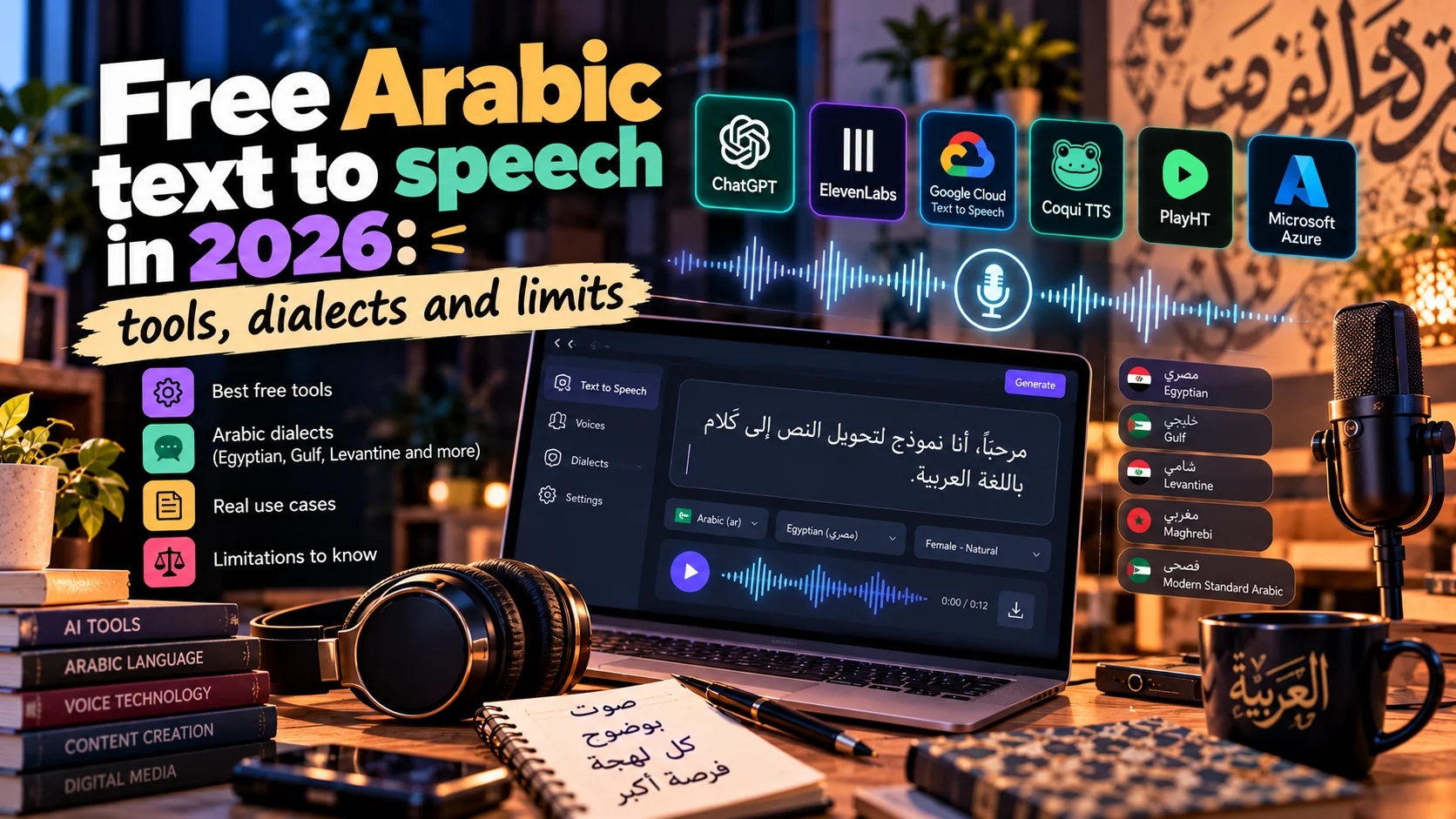
Arabic text to speech turns written Arabic into a spoken audio file, and in October 2026 you can do it for free in several places. Google AI Studio reads Standard and Egyptian Arabic with Gemini's speech models. ElevenLabs' free plan reads Arabic on a small monthly allowance. Microsoft's Azure AI Speech has voices for sixteen Arab countries inside a free quota. And CapCut puts text to speech inside its video editor.
"Free" hides two questions: how much you get each month, and whether the free tier allows client work. The answers differ a lot. A third question no tool answers for you: will your script be read correctly? Arabic is usually written without short vowels, spoken in many dialects, and mixed with English names in the same line.
Below: the free and low-cost tools that speak Arabic well, from their official pages in October 2026, a comparison table, and a method for natural Arabic from any of them.
What to check in a free Arabic voice tool
- Dialect. Standard Arabic only, or Egyptian and Gulf voices too? A country label doesn't promise the dialect, so listen.
- The free allowance. Characters, credits or daily limits?
- Commercial use. Is an ad or a client video allowed? Is a credit to the tool required?
- Privacy. Some free tiers use what you type to improve their products.
- Export. Do you get an audio file, or can you only listen?
Google AI Studio and Gemini speech generation
Google AI Studio is Google's web playground for Gemini models. You sign in with a Google account, open its speech generation page, paste a script, pick a voice and generate the audio. On 23 September 2026 Google announced Gemini 3.8 Flash TTS and Gemini 3.8 Flash-Lite TTS for developers in AI Studio and the Gemini API.
Arabic and dialects
Gemini's speech generation docs list three Arabic entries for both models in October 2026: Standard Arabic in Arabic script, Standard Arabic in Latin script, and Egyptian Arabic. There is no Gulf or Levantine entry. Google says the Flash model suits regional accents and minority dialects.
How you steer the accent matters. The docs advise against putting permanent accent changes in the style instruction. Pick a regional voice from the extended voice library instead, or create one with voice design, where you describe the role, accent and character of the voice. Style instructions are for emotion, pace and tone. So for a Saudi accent, describe it in voice design, then have a Saudi listener check it.
The free terms
Gemini's pricing page says Google AI Studio is free of charge in all available regions, and both 3.8 speech models have a free API tier. Daily limits are shown inside AI Studio. Three points from the terms matter for work:
- Your script is not private on the free tier. The Gemini API terms say content sent to unpaid services, AI Studio included, is used to improve Google's products, that human reviewers may read it, and that you should not submit sensitive, confidential or personal information. Don't paste an unreleased campaign script.
- Ownership. Google says it won't claim ownership of generated content, though it may generate similar content for others. The terms don't forbid commercial use, and describe the services as meant for professional or business purposes. You must be 18 or older.
- Watermarking. Google says every clip from its Gemini Audio models carries a SynthID watermark.
So AI Studio is the best free place to audition Arabic voices and make drafts. For sensitive client work, the pricing page says paid-tier data is not used to improve Google's products.
ElevenLabs' free plan
ElevenLabs reads Arabic on its free plan. Its docs list Arabic for Eleven v4 and Eleven v3, and for Multilingual v2 as "Arabic (Saudi Arabia, UAE)". The free plan gives 10,000 credits a month in October 2026, and the pricing page counts text to speech at one credit per character: enough to audition voices and a few short scripts, not a series.
The dialect comes from the voice. In the Voice Library, choosing Arabic in the language filter reveals an accent filter. Some library voices are closed to free users, by the owner's choice or because they cost more credits. Voice Design is on the free plan, so you can describe an Egyptian or Saudi voice and hear the previews.
Then the catch. ElevenLabs' help centre says the free plan "does not include a commercial license and cannot be used for any commercial purpose", and that anything you publish from it must credit "elevenlabs.io" or "11.ai" in the title. Paid plans include a commercial licence; the first, Starter, is listed at 6 US dollars a month in October 2026, as an example rather than a promise. For an ad or a client, the free plan is not an option.
Microsoft: Edge to listen, Azure to produce
Read aloud in Edge
To simply hear a page or a script, use Microsoft Edge. Select the text, right-click and choose Read aloud selection. Microsoft says that online it offers dozens of natural-sounding voices across languages and regional accents, including in the Edge app on iOS and Android, with only a few voices offline. Look for an Arabic voice in Voice options; the list varies with device and connection.
Microsoft's pages describe reading aloud, not saving audio, so use it to proofread a script by ear.
Azure AI Speech
For production, Azure AI Speech lists Arabic voices for sixteen countries, one female and one male each: Salma and Shakir for Egypt, Zariyah and Hamed for Saudi Arabia, plus the UAE, Kuwait, Qatar, Jordan and others. They are Microsoft's standard voices, not its newer HD ones, a closer fit for explainers, courses and apps than for acting. A country label tells you the accent a voice was built on, not whether it reads in dialect, so test your own script.
The free tier (F0) gives half a million characters a month for neural voices, per the pricing page in October 2026. No code is needed: Audio Content Creation, in Speech Studio or the Microsoft Foundry portal, lets you paste text, pick a voice, adjust pronunciation, pauses, rate and pitch, and export WAV or MP3, up to 20,000 characters per file. Microsoft says the tool is free and you pay only for Speech usage, but it needs an Azure subscription and a Speech resource.
The commercial line sits in Microsoft's Product Terms: "For Customers of the paid tier TTS Service only", customers may use the audio of prebuilt neural voices, including for commercial purposes. Test on the free tier; generate the final client audio on a paid one.
CapCut: text to speech inside the edit
If you already cut Reels in CapCut, text to speech lives in the editor: add text, choose Text to speech, then a language and a voice. CapCut's pages describe male and female Arabic voices, and say what you see varies by region, account and version, so the voice list in your own app is the reference. They name no specific Arabic dialects.
CapCut's text-to-speech FAQ says the audio can be used in ads and YouTube videos under CapCut's terms, while its Terms of Service send company content such as templates and effects to a separate licence agreement. Read both before a client campaign. How I keep posts and Reels on-brand is in social media post design with AI.
Free Arabic text to speech compared
| Tool | Arabic and dialects | Free allowance (October 2026) | Commercial use on free? | Best for |
|---|---|---|---|---|
| Google AI Studio (Gemini) | Standard and Egyptian listed; other accents through voice design | Free, daily limits shown in your account | Not forbidden, but your input improves Google's products | Auditioning voices, voice design, drafts |
| ElevenLabs Free | Arabic in v4, v3 and Multilingual v2; dialect depends on the voice | 10,000 credits a month | No, and publishing requires a credit | Trying the library before subscribing |
| Azure AI Speech (F0) | Sixteen Arab countries, Egypt and Saudi Arabia included | Half a million characters a month | No; the grant is for the paid tier | One country's accent, explainers, apps |
| Edge Read aloud | Natural voices in many languages | Free in the browser | Not an export tool | Proofreading by ear |
| CapCut | Male and female Arabic voices, by region | Varies by account and region | Its FAQ says yes, under its terms | Reels cut in the same editor |
How I would choose
- Egyptian Arabic for free: start in AI Studio, then compare Azure's Salma and Shakir on the free tier.
- A Saudi or Gulf accent: Azure's country voices, or a voice designed with that accent, judged by a listener from that country.
- Standard Arabic for a course: any of the first three; choose with the hardest line of your script.
- An ad or a client video: a paid plan with a clear commercial licence.
- Proofreading: Edge is enough.
For free options beyond voice, see free AI alternatives.
Getting natural Arabic out of any tool
A voice reads what you wrote, not what you meant.
Pick the dialect, then write in it
Arabic speakers move between Modern Standard Arabic, the language of news and formal writing, and the dialect they speak at home. A voice labelled Egyptian reading a formal script gives you formal Arabic with an Egyptian accent, not Egyptian speech. Write the script in the dialect you want, choose a voice whose samples already speak it, and don't mix the two. If you don't speak the dialect, have a native writer adapt the script; a translation tool tends to hand you formal Arabic.
Vowel marks only where the voice slipped
Arabic is normally written without short vowels (the harakat), so the voice guesses them from context. Generate once, listen, and add marks only to the word it misread:
- مدرسة can be madrasa, a school, or mudarrisa, a female teacher. The shadda, the doubling mark, alone separates them.
- عقد can be ʿaqd, a contract, or ʿiqd, a necklace.
Then regenerate that line alone. If the voice still gets it wrong, use a synonym with one reading.
Punctuation is your pause control
Arabic writing often runs a paragraph on commas, which a voice reads in one breath.
- A full stop is a full pause, a comma a short breath, a new line a change of idea.
- A question mark changes the melody, so keep it.
- An ellipsis reads as hesitation, according to Gemini's docs, so use it only for that.
- An exact pause: write
<short pause>or<long pause>in Gemini, or add a break in Azure's editor.
Numbers, symbols and English words
- Numbers: write them as words in your register. In formal Arabic a number changes with the noun's gender and with grammar, and each dialect says it differently again. Phone numbers go digit by digit.
- Symbols: no slashes, ampersands or hash signs. Write them out or cut them.
- English words: a Latin word in an Arabic line can make the voice switch accent mid-sentence. Spell it in Arabic letters as it sounds, such as آيفون for iPhone, or keep it in Latin if the voice says it well. "AI" may be read as two letters, so write it the way you want it heard.
Short lines, one at a time
One idea per line. Short lines give the voice places to breathe, and long paragraphs tend to drift towards the end. When the voice slips, you regenerate one line, not the paragraph, which stretches a free allowance too. More on that in saving AI credits.
From my work
The AI video series I direct at SkillUp MENA move through script, stills, motion, voice and edit, with AI as my tool at each step and every creative decision mine. Voice is a step with its own script and review, so it pays to know each tool's limits and terms before you start.
Building a film from still images? The whole route is in my guide to turning images into video with AI.
Next step: a full voice over
This article is about tools and pronunciation. When the voice becomes narration for an ad or a brand film, more decisions follow: writing for the ear, directing the delivery, mixing with music, knowing when to hire a human, and consent before any cloning. They are all in my Arabic AI voice over guide.
Conclusion
The best free Arabic text to speech in October 2026 depends on the job: Google AI Studio for Standard and Egyptian Arabic and voice design, ElevenLabs' free plan to try its library, Azure for one country's accent, Edge to proofread by ear, and CapCut when you are in the edit anyway. Free suits tests and drafts; client work needs a plan that allows commercial use. And with any tool, natural Arabic starts on the page: one dialect, vowel marks on the ambiguous word, clear punctuation, numbers as words, short lines.
If you want a brand video with an Arabic voice that sounds like your audience, tell me about your project.
Questions people ask
What is the best free Arabic text to speech in 2026?
It depends on the job. In October 2026 Google AI Studio is the strongest free place to audition Arabic voices, with Standard and Egyptian Arabic listed for Gemini's speech models. Azure's free tier suits a specific country's accent, and ElevenLabs' free plan lets you try its voice library before you pay. For client work, use a paid plan with a commercial licence.
Is there a free Egyptian Arabic text to speech?
Yes. Gemini's documentation lists Egyptian Arabic for its speech models, which you can try for free in Google AI Studio, and Azure AI Speech has two Egyptian voices, Salma and Shakir, inside its free monthly quota. Write the script itself in Egyptian Arabic, or you will hear formal Arabic with an Egyptian accent.
Is ElevenLabs free for Arabic?
Its free plan reads Arabic and gives 10,000 credits a month in October 2026, with text to speech counted per character. It has no commercial licence, anything you publish must credit elevenlabs.io or 11.ai in the title, and some library voices are closed to free users.
Can I use free text-to-speech audio commercially?
Not always. ElevenLabs' free plan cannot be used for any commercial purpose, and Microsoft's Product Terms grant commercial use of Azure's prebuilt voices to paid-tier customers only. Google says it won't claim ownership of Gemini output, and CapCut points to its own terms and licences. For client work, use a paid plan and keep a copy of the terms.
Does Google AI Studio text to speech support Arabic?
Yes. In October 2026 the Gemini 3.8 Flash TTS and Flash-Lite TTS models list Standard Arabic and Egyptian Arabic. There is no separate Gulf entry, so for a Saudi or Emirati accent you describe it through voice design and check the result with a native listener.

Keep reading
ElevenLabs Arabic text to speech: an AI voice over guide (2026)
Yes, ElevenLabs speaks Arabic. How to get natural Arabic text to speech from it in 2026: Egyptian or Gulf voices, vowel marks, scripts and the licence.
How to save AI credits: images, video, voice and vibe coding
How to save AI credits and tokens with a method, not tricks: brief first, draft cheap, animate an approved still, edit one part, and lean Claude Code habits.
Free alternatives to paid AI tools, and what you give up (2026)
Free alternatives to paid AI tools for chat, images, video, voice, layouts and code in 2026: where each free tier bites, and when paying is worth it.