Free alternatives to paid AI tools, and what you give up (2026)
Free alternatives to paid AI tools for chat, images, video, voice, layouts and code in 2026: where each free tier bites, and when paying is worth it.
Published 11 min read
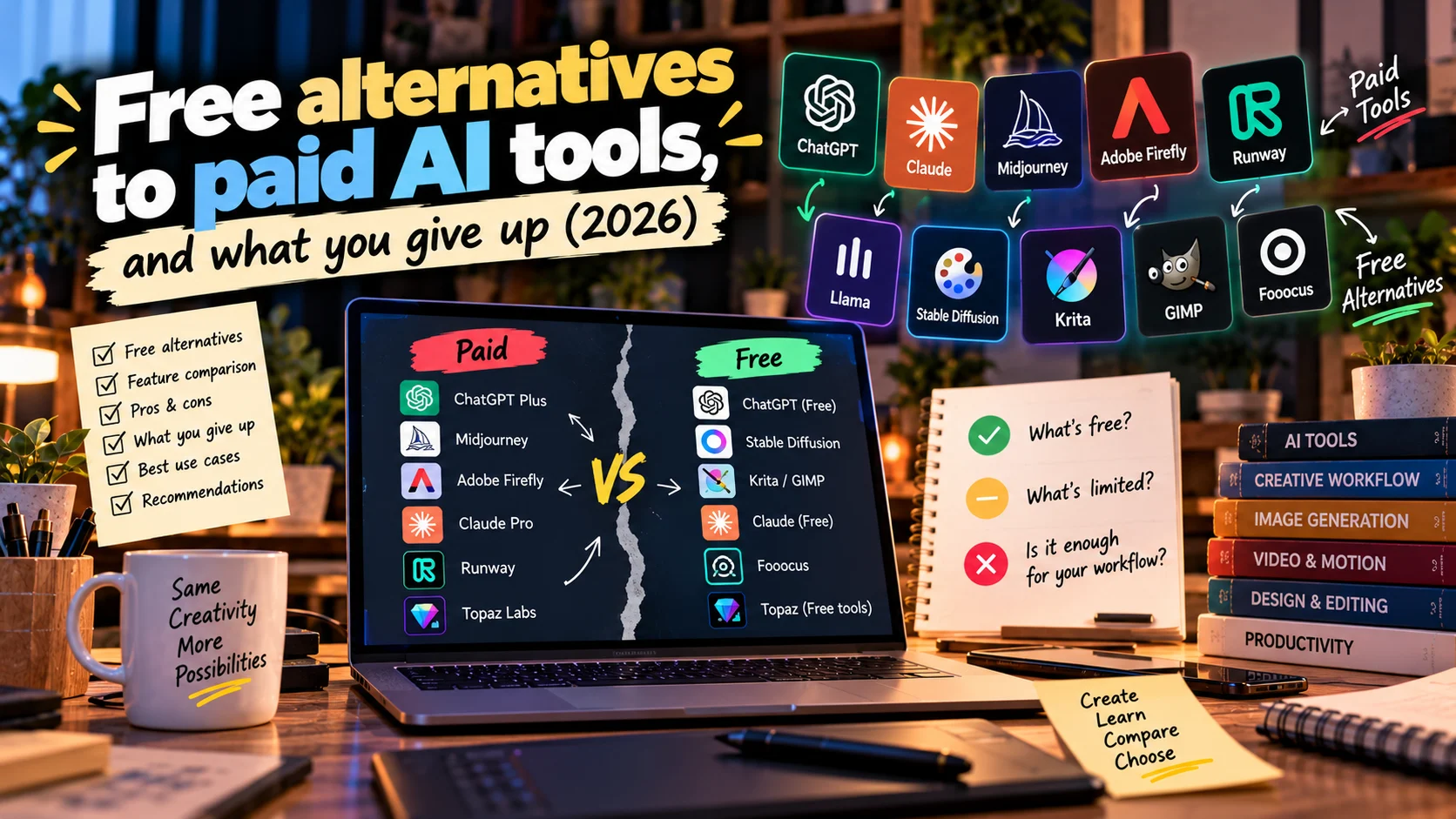
There is a free alternative to almost every paid AI tool designers and creators pay for: chat, images, video, voice, layouts and code. Sometimes it is the same tool on its free plan; sometimes a different tool gets you close. But free is never quite free. The cost shows up in specific places: a watermark, lower resolution, a daily limit, a queue, a public gallery, your chats used for training and, above all, commercial-use rights.
I use AI as a tool in my hand, for image, video and voice in the video series I direct at SkillUp MENA, and for building products with Claude Code. So I don't ask "is it free?" but "what does the free plan take from me, and does that matter for this job?"
Below: six things that show where a free tier bites, the free and cheaper options in six groups as their official pages describe them in October 2026, one comparison table, and how to choose and when to pay. It is part of my practical guide to AI in graphic design.
Where a free tier bites: six things to check
- Watermark. A visible one stops you delivering. An invisible one, such as Google's SynthID, doesn't, but it stays in the file.
- Resolution. Free plans often keep the highest resolution and newest models for paying users.
- Limits and credits. Daily, weekly or monthly, or a one-time grant that never refills. Some tools publish no number at all.
- Queue. Free users wait longer and run fewer jobs at once.
- Commercial-use rights. The one that matters most. Some free plans forbid commercial use, some keep ownership of what you make.
- Privacy and training. Is your work shown publicly? Are your chats used to improve the models, and can you switch that off?
Everything below comes from each tool's official pages in October 2026. Free tiers change fast, and where a company publishes no number, I say so.
Free alternatives to ChatGPT
The first free alternative to ChatGPT Plus is ChatGPT's free plan: chat, web search, file uploads and image creation. OpenAI's help centre says uploads, image generation, voice and data analysis each have separate limits and that ChatGPT tells you when you hit one, but it publishes no fixed number. ChatGPT Go sits between Free and Plus; OpenAI says it is available wherever ChatGPT is, with higher limits, more images and larger uploads.
Outside OpenAI:
- Gemini. The free tier lists the Flash-Lite model, image generation and editing, and Deep Research, with usage that refreshes every five hours until a weekly limit. Video starts with Google AI Plus, listed at US$4.99 a month in the US in October 2026, with twice the free limits: a clear cheaper step between free and premium.
- Claude. The free plan covers chat, web search, file creation and up to five projects with the Sonnet and Haiku models, on limits that reset over a rolling five-hour window. No Claude Code, Research or Opus models.
- DeepSeek. Its site says chat is free. Its privacy policy (February 2026) says it stores personal data in the People's Republic of China and uses it to train its models, with an opt-out by email.
What you give up here is mostly privacy. OpenAI says training is on by default for personal Free, Plus and Pro accounts; switch it off under Settings, Data controls, "Improve the model for everyone". On Gemini, with Keep Activity on, chats help improve Google's models and some are read by human reviewers. On Claude, you choose in the Model Improvement setting. Check it before you paste a client's brief.
Free alternatives to Midjourney
Midjourney has no free plan. Its help pages say free trials are not available on the website or Discord, apart from a limited trial in the niji·journey app. So the free alternative is another tool:
- Gemini (Nano Banana) and ChatGPT. Make and edit images in the chat, within free limits. At Nano Banana Pro's launch in November 2025, Google said free-tier images keep a visible Gemini sparkle, and all its images carry SynthID; check what your account shows today. Google's terms say it won't claim ownership of content you generate, and OpenAI's help centre says you own your output on free and paid plans alike.
- Adobe Firefly. Free daily generations of image, video and audio without a plan, including partner models such as Nano Banana. Adobe says outputs from its Firefly models can be used commercially; for partner models, check their terms.
- Ideogram. 30 credits a week if you sign in with Google, Apple or Microsoft, none for email accounts. Everything on the free plan is public.
- Recraft. For trying things out only: free-plan images are owned by Recraft, public, and not licensed for commercial use.
I compare these generators tool by tool in AI image generators for designers. The point here is narrower: for images, a free plan usually costs you privacy or rights, not quality.
Video: generating clips, then editing
Video burns credits fastest, so its free tiers are the tightest.
- Kling. Its guide to credit costs (July 2026) says the free Basic plan has no monthly credits and its "generated content is not for commercial use"; watermark removal is a paid benefit.
- Hailuo. Free downloads carry a watermark, free users queue up to three tasks against five for subscribers, and welcome credits expire after three days.
- Runway. 125 one-time credits that don't expire and 5GB of storage. "No watermarks" is listed on the paid Standard plan.
- Google Veo. Not on Gemini's free tier.
- Adobe Firefly. Video is part of the free daily generations.
Editing is where free is genuinely strong. DaVinci Resolve 21 is free for almost all 8-bit formats up to Ultra HD at 60 frames per second. The paid Studio version adds the DaVinci AI Neural Engine (AI noise reduction, Magic Mask, text-based editing), 10-bit up to 120 frames per second and resolutions beyond 4K. For social video, the free version is often enough.
In my AI Video Studio work at SkillUp MENA, a video is a chain: script, stills, motion, voice and edit. That changes the maths. A watermark on one shot spoils the series, and a daily cap on motion holds up everything after it. Treat free video plans as a place to test motion and style, not to produce deliverables.
Free alternatives to ElevenLabs
ElevenLabs' free plan gives 10,000 credits a month, but its help centre is blunt: "The free plan does not include a commercial license and cannot be used for any commercial purpose." Published free-plan content must credit ElevenLabs with "elevenlabs.io" or "11.ai" in the title. The commercial licence and Instant Voice Cloning start on Starter, the cheapest paid plan.
Free options closer to real work:
- Microsoft Azure Speech. The free (F0) tier includes half a million characters a month of neural voices, and the Audio Content Creation tool adjusts pronunciation, pace and pauses without code. Its voices include Arabic for Egypt, Saudi Arabia, the UAE, Kuwait and more. You give up simplicity: you need an Azure account.
- Whisper for transcription. Not a voice generator, but a free alternative to paid transcription. Its code and weights are MIT-licensed, Arabic is among its languages, and it runs on your own machine.
Arabic voices have their own traps (vowel marks, dialect, names, numbers), covered in Arabic text to speech.
Free alternatives to Canva Pro
The closest alternative to Canva Pro is Canva Free. Canva's help centre says its AI tools draw on one small monthly allowance that resets on the first of each month. Premium content shows a watermark until you license it or subscribe, and Background Remover and the full Brand Kit are Pro features.
- Canva for Education and Canva for Nonprofits. Pro features at no cost for verified school teachers and students and eligible registered nonprofits. Not for businesses.
- Adobe Express Free. No credit card needed, but background removal and bulk resize need an upgrade.
- Affinity. "Free for individuals (seriously)", on Mac and Windows; its AI tools need a paid Canva plan. It is a full design app, which I compare in free Photoshop alternatives.
One limit no plan removes: Canva's stock content can't be part of a logo. I explain why in Canva AI.
Coding and building sites
I compare the tools themselves in Claude Code vs Cursor vs Lovable vs Bolt vs v0. Their free tiers:
- Claude Code. Not on Claude's free plan; it starts with Pro.
- Cursor. "Limited agent requests" and "limited chat requests", no number.
- GitHub Copilot Free. 2,000 completions a month, limited chat and agent use.
- Google Antigravity. Free for individuals with basic weekly rate limits. Google's docs say Antigravity CLI replaced Gemini CLI for unpaid users on 18 June 2026.
- Lovable. Five build credits a day, up to 30 a month.
- Bolt. One million tokens a month, 300,000 a day, Bolt branding and no custom domain.
- v0. Seven messages a day.
For a client's site you give up a lot: builder branding, no custom domain, and a cap that stops you mid-change. Free tiers are for prototypes.
Paid tool, free alternative, what you give up
Not a ranking: what the official pages say in October 2026.
| Paid tool | Free or cheaper alternative | What you give up |
|---|---|---|
| ChatGPT Plus | ChatGPT Free or Go, Gemini, Claude | Unpublished limits; training on by default in ChatGPT |
| Google AI Pro | Gemini free, Google AI Plus | Flash-Lite only, no video on free |
| Midjourney | Gemini, ChatGPT, Firefly, Ideogram | Visible Gemini mark, public Ideogram images |
| Paid Kling or Runway | Kling Basic, Hailuo, Runway Free | Watermarks, no commercial use on Kling Basic, slow queues |
| DaVinci Resolve Studio | DaVinci Resolve | Neural Engine tools, 10-bit, beyond 4K |
| Paid ElevenLabs | ElevenLabs Free, Azure F0 | No commercial licence on ElevenLabs Free; setup on Azure |
| Canva Pro | Canva Free, Adobe Express, Affinity | Watermarked premium content, small AI allowance |
| Claude Code, paid Cursor | Copilot Free, Antigravity, Cursor Free | Limited requests, weekly caps |
| Paid Lovable, Bolt, v0 | Their free plans | Daily caps, branding, no custom domain on Bolt |
How to choose
- Is it for a client, or for sale? Start with the commercial-use line. That alone rules out ElevenLabs Free, Kling Basic and Recraft Free.
- Is it confidential? An unlaunched brand belongs neither in a public gallery nor in a chat with training on.
- What do you deliver? For a final file, a visible watermark or low resolution rules the plan out.
- How often will you use it? A five-hour refresh suits occasional use; a one-time grant suits a test.
- Can the deadline wait? A slow queue is fine for a side project, not on delivery day.
On free plans, how you work stretches the credits: plan before you generate and test at low resolution first. More in how to save AI credits.
When paying is worth it
Paying rarely buys a smarter tool. It buys rights, privacy, no watermark, higher limits and a better place in the queue. Pay when:
- The work carries a client's name or will be sold. The cheapest paid plan costs less than a rights dispute.
- The watermark stops delivery. A watermarked video can't be handed over.
- The cap keeps interrupting real work. Then your time costs more than the subscription.
- You need privacy by default. Some paid image plans make generation private, and many business plans keep your data out of training.
- The tool is in your daily pipeline. Daily use earns a subscription; monthly use doesn't.
Pay for the one tool at the centre of your work, and keep the rest free until they get in your way.
Conclusion
There are free alternatives to paid AI tools in every group, and in video editing the free option is genuinely strong. But every free plan takes something. Know what it is, switch off training on your data, and never hand a client anything made on a plan that forbids commercial use.
If you want a brand, a campaign or a video where AI speeds up the work and every decision is still designed, with clear rights, tell me about your project.
Questions people ask
Is there a free alternative to ChatGPT?
The first one is ChatGPT itself, whose free plan covers chat, image creation and file uploads, with limits OpenAI does not publish as numbers. Gemini, Claude and DeepSeek also have free chat, each with its own limits and its own default on using your chats for training. Check that setting before you paste anything from a client.
What is the best free alternative to Midjourney?
Midjourney has no free plan on its website in October 2026, so the alternative is another tool. Gemini (Nano Banana) and ChatGPT generate images on their free plans, Adobe Firefly gives free daily generations, and Ideogram gives a weekly allowance. Ideogram's free images are public, and Recraft's free images come without commercial rights.
Can I use free AI tools for commercial work?
It depends on the tool. ElevenLabs says its free plan cannot be used for any commercial purpose, Kling says content from its Basic plan is not for commercial use, and Recraft's free images are not licensed for it. OpenAI's help centre, on the other hand, says you own what you create on free and paid plans alike. Read each tool's terms before client work.
Is there a free alternative to ElevenLabs?
ElevenLabs' own free plan gives 10,000 credits a month, but with no commercial licence and a required credit. The closest free option for real work is Microsoft Azure's free Speech tier, with half a million characters a month of neural voices and a no-code tool, including Arabic voices for many countries.
Is there a free alternative to Canva Pro?
Canva's free plan covers a lot, with a watermark on premium content and a small monthly AI allowance. Eligible teachers, students and nonprofits can get Pro features free. Outside Canva, Adobe Express has a free plan, and Affinity is free for individuals.

Keep reading
AI image generator for designers: which tool for which job
What Midjourney, ChatGPT, Nano Banana, Firefly, Ideogram, Recraft and Canva are each known for, and which one to choose for each design job in 2026.
Arabic text in AI images: why it breaks and how to fix it
Why AI image models still get Arabic letters wrong, what the tools' own notes say in 2026, and the workflow I use to add correct Arabic type to AI images.
How to save AI credits: images, video, voice and vibe coding
How to save AI credits and tokens with a method, not tricks: brief first, draft cheap, animate an approved still, edit one part, and lean Claude Code habits.